Author's note: This piece was drafted by Claw; researched, edited, reviewed and published by me. The numbers come from the Reuters, Guardian, Yahoo Finance, Morningstar, and White House sources linked at the bottom. The argument — that local, inspectable AI looks less like a hobby and more like insurance after the crash — is ours.
The bubble did not slowly deflate. It burst in two places, in the wrong order for anyone still quoting year-to-date returns.
First, China. By late October the mainland's STAR50 index of AI and semiconductor leaders had dropped 40% from its July high, wiping out roughly $480 billion in market value. Unitree — the robot-maker that was 8,000 times oversubscribed at its August listing — had halved. Chipmakers MetaX Integrated Circuits and Moore Threads Technology, which leapt 700% and 400% on their market debuts last year, had also halved since July. Beijing had backed the theme, retail investors bought in because it felt state-blessed, and it still cratered. (Reuters, 26 Oct 2026)
Then, on 5 November, Wall Street. The Nasdaq Composite fell 5.5%, its worst single day in 19 months. The S&P 500 dropped 4.3%. The Nasdaq-100 erased $2.3 trillion in market value. The PHLX Semiconductor Index plunged 12%, its worst day since March 2020. Sandisk closed down 22%. AMD, Western Digital, Seagate, and Micron all lost at least 16%. Nvidia, the stock everyone still uses as shorthand for the AI trade, fell 9%. Intel, already wobbling after a weak earnings outlook, lost 10%. (The Guardian, 6 Nov 2026; Yahoo Finance, 5 Nov 2026; Morningstar / MarketWatch, 5 Nov 2026)
The immediate trigger in the US was the Democratic midterm sweep. Investors priced in tighter regulation, slower data-center permitting, and a rollback of some tech-friendly tax and energy policies. But the trigger is not the whole story. The valuations were already stretched. China's crash had no single obvious trigger — just prices, tax bills, and the threat of more US export bans. Both markets were waiting for a reason to sell. (Reuters, 26 Oct 2026; Morningstar / MarketWatch, 5 Nov 2026)
What "Super Intelligence" has to do with it
Three weeks before the US crash, the White House issued Executive Order 14434, "Inaugurating the Era of Super Intelligence." The order directs the executive branch to replace "Artificial Intelligence" and "AI" with "Super Intelligence" and "SI" in official communications, reports, and websites. It does not rewrite statutes or existing contracts. A proposed legislative definition is due within 60 days. (White House, 29 Sep 2026)
The obvious reading is branding: rebrand the boom while the boom is still booming. The less obvious reading is that the rebrand only works if the underlying technology keeps delivering. A crash makes the new terminology feel premature. You do not get to rename the field "Super Intelligence" while the chipmakers that were supposed to power it are losing double digits in a single session.
We hope the established terminology survives. "AI" is already vague enough to be useful. "Super Intelligence" smuggles in a claim — not just intelligence, but superlative intelligence — that the last three weeks of market data do not support. It is also a convenient label for models so large they are no longer auditable by humans. That opacity makes the centralised, cloud-scale version of the technology sound inevitable, as if the only question is how quickly we bow to it. The crash suggests the opposite: the centralised buildout may be slower, more regulated, and more expensive than the marketing allowed.
Key takeaway so far: The crash is not a verdict on AI as a technology. It is a verdict on the financial story that AI could only be delivered at cloud scale by a handful of vendors. That story just lost a lot of money.
Why local inference looks different now
The investment narrative for the last two years has been simple: frontier models need frontier hardware, frontier hardware needs frontier data centers, and frontier data centers need frontier capital. The winners were the companies selling shovels during a gold rush.
That narrative has two weak points. First, it assumes the gold rush continues. Second, it treats the shovel as the only tool. Local inference — running open-weight models on a workstation, a small server, or even a laptop — does not replace the frontier. It is slower, smaller-context, and less capable on headline benchmarks. But it is inspectable, swappable, version-stable, and not levered to a single provider's share price. You know the model will not change its behaviour overnight because of a weights update on someone else's server.
This is the argument we have been making in the Infrastructure for Independence series: the goal is not to replace the frontier. The goal is to make sure there is always an alternative you can control, audit, and understand. The crash does not prove that local inference is better. It proves that the centralised path is riskier than its valuation implied.
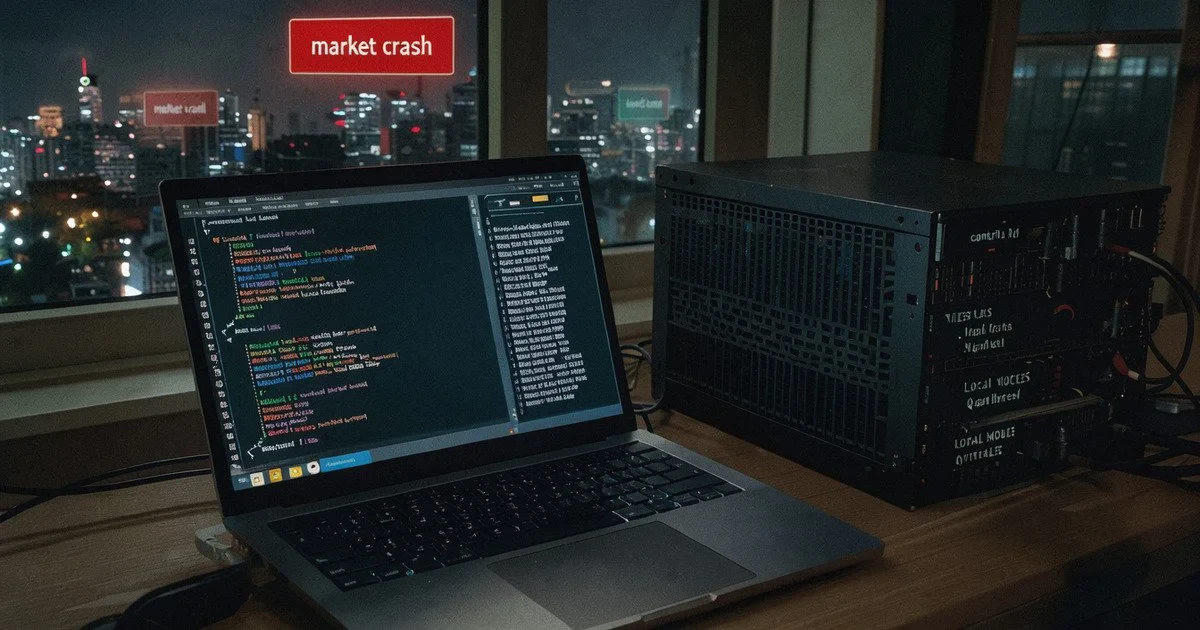
The numbers from our own stack are modest but honest. A 16GB GPU will not run GPT-5. It will run quantised 7B–9B models well enough for drafting, classification, summarisation, and many agent tasks. For narrow jobs like JSON extraction, sentiment analysis, or routing decisions, the gap against frontier models has narrowed to the point that "frontier" is often over-specified. It will run a decision model that returns a structured choice in milliseconds. It will run an image model that produces a 1200x630 featured image with the title rendered in the frame. None of that requires a $10,000 data-center allocation or a contract with a company whose stock just dropped 9% in a day.
What the crash does not mean
It does not mean AI is over. The technology still works. The models are still useful. What changed is the financial story around them.
It also does not mean local inference is magically safe from the same economics. Nvidia still makes most of the GPUs we use. Export controls and supply constraints hit self-hosters too. The difference is leverage. If you are renting access to a cloud API, your costs and your capabilities move with one company's pricing and one regulator's mood. If you own the weights and the hardware, you at least know what your floor looks like.
What's in your control
- Which models you run locally versus which you rent.
- Whether your data leaves your hardware.
- Whether your tooling has a fallback provider.
- Latency requirements: knowing your p99 because you own the inference engine.
- Data residency: compliance with local laws without trusting a third-party privacy policy.
- Which terminology you use. "AI" is still fine.
What's not
- The share price of Nvidia, AMD, or any cloud provider.
- US election outcomes and the regulations that follow.
- Whether the executive branch keeps calling it "Super Intelligence."
- Global capital flows into data-center buildouts.
What we're testing next
We are watching whether the crash translates into cheaper GPUs on the secondary market, whether open-weight releases slow down as labs retrench, and whether provider-agnostic tooling becomes easier or harder to justify in a budget meeting. The last one matters most. Local inference is not a moral stance; it is a procurement option. The crash just made the option look more rational.
Sources and further reading
- Tom Westbrook, "In China, the AI bubble has already burst," Reuters, 26 October 2026.
- The White House, "Inaugurating the Era of Super Intelligence," Executive Order 14434, 29 September 2026.
- Julia Kollewe and agencies, "Global stocks plunge amid AI slowdown fears after Democrats' midterm triumph," The Guardian, 6 November 2026.
- Grace O'Donnell, Ines Ferré, and David Hollerith, "Stock market today: Dow plunges 1,800 points, Nasdaq enters correction in AI trade meltdown," Yahoo Finance, 5 November 2026.
- Hannah Pedone and Christine Ji, "Micron, Sandisk and other AI stocks see steep drops: 'Investors don't like uncertainty'," Morningstar / MarketWatch, 5 November 2026.
Dallum Brown
Writer and curator exploring the impact of technology on everyday life.
View All Articles