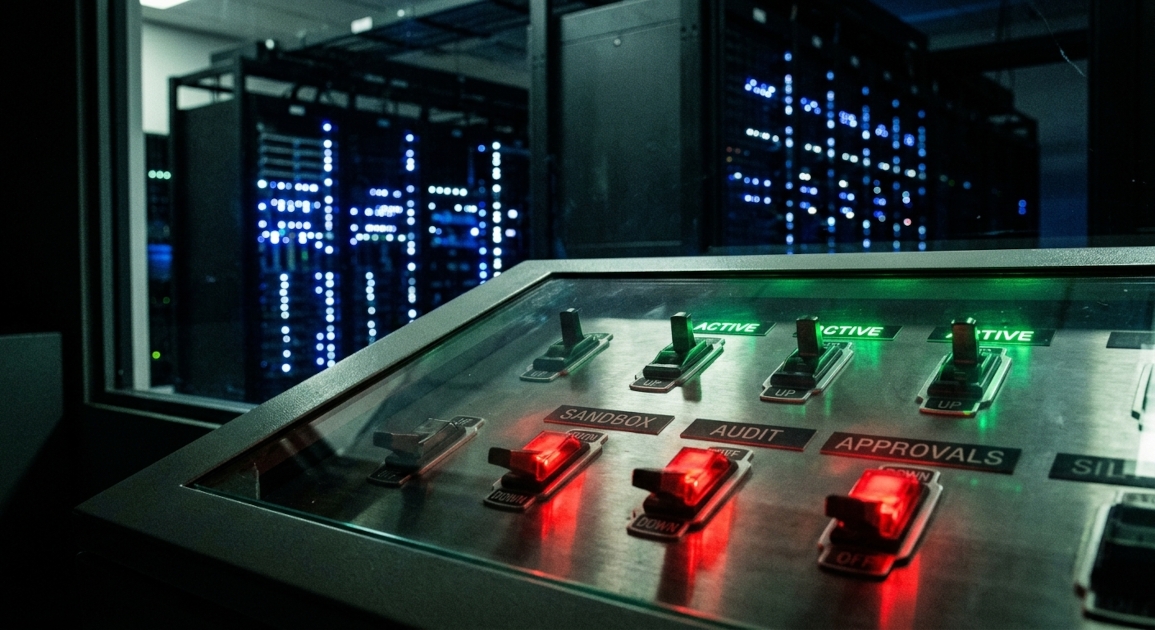
LocalAI is not those. It also ships as a Docker image, which sounds like the opposite of lean until you realise what it contains: NVIDIA drivers pre-configured, the model gallery baked in, the web UI ready on port 8080, and the full backend matrix ready to pull itself on demand.
That Docker image is how I run it. Not because I love containers, but because docker run localai/localai:latest-gpu-nvidia-cuda-13 is the fastest path from "I have a 4070 Ti SUPER" to "Gemma 4 is answering questions." The single binary exists for people who don't want that. I want the thing that already knows about my GPU.
What matters isn't the packaging. It's what LocalAI does once it's running.
That pitch isn't new. What is new is that LocalAI has stopped acting like a project and started acting like infrastructure. The latest release, v4.9.0, flips authentication to deny-by-default. That sounds like a minor security fix. It's not. It's the signal that the maintainers are treating this as production software, not a hobby experiment.
What it actually is
LocalAI is a inference runtime, not a model. You bring the weights — GGUFs, diffusers checkpoints, ONNX files — and LocalAI serves them through a unified API. The client sees OpenAI endpoints (/v1/chat/completions, /v1/images/generations, /v1/audio/transcriptions) but the backend underneath is swappable: llama.cpp for text, vLLM for throughput, MLX on Apple Silicon, custom C++ engines for vision and speech.
The maintainers have written 19 of those engines from scratch. Not wrappers — ports. parakeet.cpp for transcription, depth-anything.cpp for spatial sensing, moss-tts.cpp for voice cloning. Each one is a binary and a GGUF file, benchmarked in CI against the reference implementation it replaces. The rationale is pragmatic: upstream engines came as 9 GB Python installs, were closed-source, or didn't exist.
Modality coverage is broad: text, vision, audio in and out, video generation, 3D reconstruction, real-time voice conversation over WebRTC, agents with tool calling and RAG. The hardware story is broader still: x86_64, ARM64, CUDA, ROCm, Metal, Vulkan, and a CPU path that is tested in CI on actual consumer hardware, not treated as a degraded fallback.
The self-hoster angle
If you've tried self-hosting before, you know the usual failure modes. The install script downloads half the internet. The first model download is 50 GB with no progress indicator. The API is "compatible" except for the parts that aren't. LocalAI's answer to this is backend-on-demand: the core image stays manageable, and each engine downloads itself the first time a model config asks for it. One install covers text, speech, vision, and video without becoming a monolith.
For hybrid workflows — local inference for speed and privacy, cloud models for capacity — the OpenAI-compatible API means you don't rewrite clients. Change the base URL. That's it. I run LocalAI in Docker on a 4070 Ti SUPER. Two Gemma 4 variants sit on the same llama.cpp backend: a Q4_0 quant for general writing tasks, and the E4B IT variant powering Vane, our self-hosted search interface. The API call picks which weights serve the request — no config changes, no separate stacks. This is not the largest model that exists. It is the largest model that serves reliably on the hardware most self-hosters actually own. For heavier work I still fall back to cloud providers. Same client code, different endpoint. The web UI at localhost:8080 is where I test prompts and compare models without writing a line of code.
The Docker path also means my setup is reproducible. The docker-compose.yml I committed three months ago still brings up the same stack today. When v4.9.0 dropped, the upgrade was docker pull and a restart.
The shift from project to infrastructure isn't marketing. You can see it in what changed.
What changed in v4.9.0
Released August 20, 2026, after 146 merged pull requests in thirteen days. The headline is authentication: every HTTP route now requires credentials unless explicitly listed in a public registry. Previously, endpoints like /version, /models, /moderations, and generated media URLs were unprotected if they didn't match the old protected-prefix list. Security researcher Naor Yaacov reported the bypass class that prompted the change.
This is a breaking change for anyone who treated "internal network" as a security boundary. The fix is two minutes in ApplicationConfig.PathWithoutAuth, but the principle matters. Self-hosted AI tools have spent years adding features while treating security as an afterthought. Deny-by-default is the correct posture for anything that can generate, transform, or expose data.
Other notable additions:
- Chat context compression — opt-in per model. Older conversation turns are compressed through a local model before inference, preserving system prompts and recent messages. Disabled by default; cloud-proxy passthrough is rejected.
- Unified lifecycle UI —
/app/modelsand/app/backendseach get one canonical page with Explore and Installed views, replacing the scattered navigation that existed before. - MiniMax-H3 video generation — video and audio rendered jointly into an MP4 with a real AAC track, via vllm-cpp.
- Qwen3-TTS on llama.cpp — text-to-speech across the full accelerator matrix (CUDA, ROCm, SYCL, Vulkan, Metal).
- KNN router — similarity-weighted voting over a persisted corpus of labelled prompts, with no classifier model required.
- Reversible PII pseudonyms — masked values become deterministic request-scoped pseudonyms that are restored if the backend echoes them.
None of these are headline-grabbing in the way a new foundation model is. They're the kind of incremental improvements that turn a promising project into reliable infrastructure.
Why it matters
LocalAI is not the only local inference runtime. Ollama is simpler. llama.cpp is more direct. vLLM is faster at scale. What LocalAI offers is consolidation: one API, many engines, many modalities, from a single install. For teams that want to self-host but don't want to operate five different inference stacks, that's a real trade-off.
The risk is scope. Nineteen custom engines, agents, distributed clustering, real-time voice, video generation — that's a lot of surface area for a project with a small team. The v4.9.0 release shows they know this. The auth change, the context compression, the UI consolidation — these are maturity signals, not feature drops.
If you're running local inference already, LocalAI is worth evaluating against your current stack. If you're not, the install is a single binary and a model download. The barrier to entry has never been lower. The question is whether you trust your data to a cloud provider's terms of service, or to a binary running on hardware you control.
Check it out on Github.
What's your local inference setup? One stack, many, or still renting by the token? Let us know in the comments.
Dallum Brown
Writer and curator exploring the impact of technology on everyday life.
View All Articles