On Thursday, October 15, Meta published what it calls "the most capable US open-weight model to date." By Friday, China's Ministry of Commerce had posted a draft that could put its own frontier models — open weights included — behind an export gate. And the week before, Meta had quietly set October 30 as the date its new commercial terms take effect for every business account still logging in.
Three events, seventy-two hours apart, one pattern. Our read, stated plainly: the question for self-hosters is no longer "which model can I run?" but "who gets to decide whether I can download it — and when do I accidentally agree to something?" Open is not a property of weights. It's a property of terms, and the terms are changing under the feet of both the vendors and the states.
The front door with an application form
The numbers are genuinely impressive: Muse Spark Open is an 816-billion-parameter mixture-of-experts with about 42B active per token, a 1M-token context window, and a multimodal architecture. Artificial Analysis put it first among US open-weights models on its Intelligence Index. Meta's "local" pitch for running it is two Mac Studios with M5 Ultra chips wired together — which tells you this release isn't aimed at a workstation class we live in. A 1.6 TB weight dump (that's the BF16 sum of its 65 published shards) doesn't quantize into 16 GB of VRAM any year soon.
But the interesting number isn't 816. It's what we found when we checked the Hugging Face repo directly instead of taking the announcement's word:
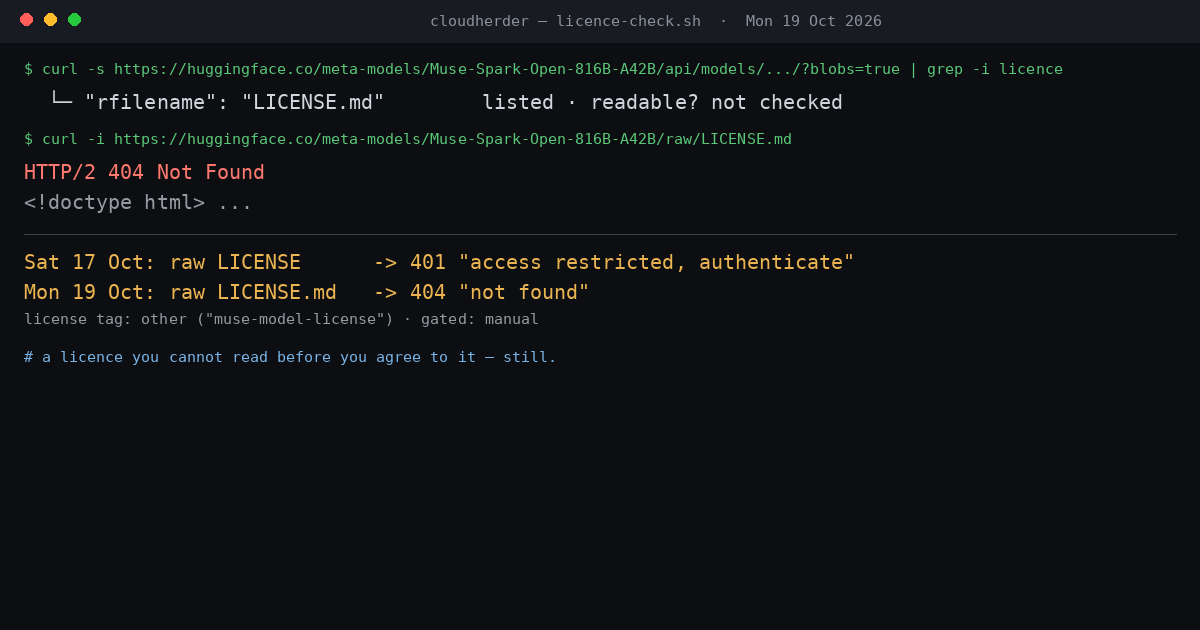
gated: manual— you apply for access and wait for approval.license: other— and its license file refuses to be read. On Saturday, fetching raw LICENSE answered: "Access to model meta-models/Muse-Spark-Open-816B-A42B is restricted. You must have access to it and be authenticated." — a 401, twice. We re-checked this Monday morning:LICENSE.mdis still listed in the file manifest, and the raw fetch now returns 404 Not Found. A locked door that at least admitted a room exists has been replaced by a wall. The test — can you read the license before accepting it — still fails; the refusal just got quieter.
Read that again: the license for an "open-weight" release cannot be read before you agree to it. You have to knock, be let in, and only then find out what "open" means in writing. Meta's Llama era at least let you read the community license before clicking it.
And yet — the side doors were open before the ink dried. By the afternoon of release day, unsloth's GGUF port of the same model was on Hugging Face with gated: false and, by Monday, thousands of downloads; the ggml-org llama.cpp port is likewise ungated. Bytes move faster than bouncers. But "the mirror exists today" is not the same thing as "the mirror is guaranteed tomorrow," and a quantizer that needs the originals to build a port has to pass through the gate first. The community's openness is currently a courtesy of the release pipeline, not a property of it.
Sources: Meta model card + HF API (
meta-models/Muse-Spark-Open-816B-A42B, fetched 2026-10-17, our own requests — sizes, gating, license tag); The Guardian, "Meta releases Muse Spark Open," Oct 16 2026 (Wang quote, M5 pitch); Artificial Analysis via X, Oct 2026 (Index score 39, #1 US open-weights); unsloth + ggml-org GGUF repos via HF API (gated: false).
The state drafts the same clause
On Friday, MOFCOM and the Ministry of Science and Technology jointly published a draft revision of China's export catalogue: forty technologies, twenty-three of them AI items, stretching from large models to agents. As written, exports of "core technologies" of models trained on sensitive national data would be prohibited; models with two trillion parameters or more, or "world-leading capabilities," could be restricted.
Three honesty notes before anyone shares this on LinkedIn the way the headlines did. First, it's a public draft with a comment period, not enacted law — no models are named in the text. Second, the ≥2T threshold is doing the quiet work: AP notes Kimi K3 and Qwen's top flagship clear it; the 8B–70B models the rest of the world actually self-host don't. The draft, as written, draws a line almost exactly between the frontier and the tier that runs on hardware small teams own. Third, precedent cuts both ways: in June, US Commerce asked Anthropic to bar foreign users from two frontier models — then lifted it within weeks. States have demonstrated both the intent and the reversibility.
Sources: AP, "China moves to curb tech exports, including AI, citing national security risks," Oct 16 2026 (counts, thresholds, ministry quote, no model names, June Anthropic precedent); FT/Reuters relays (consultation stage with Alibaba, ByteDance, Zhipu).
The sleeper clause: consent by continued use
If China is drafting the boundaries of where these models can physically go, Meta is drafting the boundaries of what you can do with them once they arrive. And the clause that lands on October 30 — eleven days from today — is the sleeper. Meta's updated commercial terms — reported first by Nieman Lab on October 15 — add language authorizing Meta "to use automated software (such as web scrapers, bots, robots, spiders, crawlers, and user agents) and create test credentials" against domains "associated with" business accounts, and to use what it collects to "develop, improve, research, train" its products, where "AI at Meta" is a defined product elsewhere in the terms.
There is no opt-out mechanism. The alternative is quoted verbatim from Meta's own update: "If you do not agree to the updated terms, please stop all access or use of our Products for business or commercial purposes." Continued use after October 30 reads as acceptance. That's the mechanism, and it has a name: consent by silence.
The framing split matters, and we'll keep both sides of it. Three media-law experts reading the text for Nieman Lab described it as, in effect, a free licensing grant for training data, "a remarkable provision to bury in terms of service." Meta's own position: this consolidates crawling permissions already scattered across other terms, won't change how it crawls publishers, and — their words — "content owners can still manage how their content is accessed by using robots.txt." Enforcement against a court is genuinely unsettled; nobody's filed yet. But note what Meta just did: pointed at robots.txt as the remedy, inside a consent regime where reading the terms is optional and leaving is the only refusal.
Sources: Nieman Lab (Deck & Tameez), Oct 15 2026 — full clause quote, expert readings, "no opt-out," Meta's responses; Meta Commercial Terms preview + Meta Business Help update notice (primaries); The Verge, Oct 16 2026 (follow-up coverage).
Same tag, opposite meaning
Here's where the week resolves into one testable claim. The genuinely open release of the same week is NVIDIA's Nemotron 3.5 — shipped through Ollama v0.40.5 on October 14, a 74B/9B-active "Bolt" flavour tuned to fit a 24GB GPU. On Hugging Face its tag reads, exactly like Muse Spark's: license: other.
That tag is the whole illusion. Under the hood, Nemotron's license is OpenMDW-1.1 — published in full, linked from the card, readable by anyone without asking NVIDIA for permission. No gate, no application, no 401. Identical machine-readable tag; opposite degree of openness — because the difference was never the weights or the label. It's whether you can read the terms before accepting, and whether you can get the bytes after downloading.
One is a license with a front door. The other is a locked room with a sign that says "open."
What we're doing before October 30
Not doom — hygiene. Four moves, and we started with our own house:
- Check your robots.txt, for real. We fetched ours Saturday morning:
User-agent: *and a blankDisallow:— a blanket welcome mat for every crawler including, as Meta's own docs now specify,Meta-ExternalAgent, the one documented for "training foundation AI models." Meta's crawler index reports bots honour robots.txt about 93.8% of the time across 5,000+ sites, with the honest caveat thatMeta-ExternalFetcher"may bypass" it, because it fetches what users ask it to. - Decide your trade-off and write it down. Blocking
Meta-WebIndexeralso opts you out of being cited inside Meta AI's answers. That may be correct — but it should be a decision, not a default. And here's the twist in our own case: CloudHerder has no Meta business account — the October 30 clause, as written, doesn't bind us. But this site ships a Facebook share button, and every time a reader clicks it, their share summons Meta's fetcher against our URLs. The commercial terms didn't get us; our own widgets do, one willing click at a time. We're keeping the button — reader referral is real traffic — but naming that trade-off out loud is the minimum an independent site owes its readers. Keepfacebookexternalhitallowed regardless, or your link previews die mid-decision. The robots.txt block — shipped Saturday (e720260), re-fetched from outside to prove it:User-agent: meta-externalagent Disallow: / User-agent: Meta-ExternalAgent Disallow: / User-agent: Meta-WebIndexer Disallow: / User-agent: * Disallow: - Snapshot the terms you run on. Save the license text of every model in your stack on release day, because the terms migrate ("Max" tiers, revenue clauses, catalog revisions). The 401 we got on Muse's LICENSE is exactly the document we would have wanted archived.
- Architect the frontier as optional, the middle as load-bearing. The tier being gated in Washington and drafted in Beijing is ≥2T-parameter territory. The tier staying open is yours — Apache, MIT, OpenMDW releases land ungated every week. If your production path has a frontier-model assumption in it, that assumption is now the risk, not the model.
What's in your control: the mirrors you keep, the terms you archive, the robots.txt you ship this week. What's not: whether the next "open" release lets you read the license before the download button. What we're testing next: how far OpenMDW-style readable licenses spread, because that's the format that survives both bouncers.
The question we're actually asking this week: is there any model in your stack whose license you couldn't reproduce from memory right now? Because that's the one whose "open" you're taking on faith.
Disclosure: research receipts in this post (the 401, the gating flags, the robots.txt check) were fetched live by CloudHerder's agent during, and re-verified on, publication morning, 2026-10-19. The post was edited and signed by a human.
Sources:
- Hugging Face API —
meta-models/Muse-Spark-Open-816B-A42B(+?blobs=true), fetched 2026-10-17 and re-fetched 2026-10-19 by CloudHerder (gating: manual; license: othermuse-model-license; file manifest listsLICENSE.md; raw LICENSE → HTTP 401 with body quoted above [Sat]; raw LICENSE.md → HTTP 404 first observed 2026-10-19 ~11:15 NZDT, re-confirmed 12:28 NZDT — still 404 as publication time). - Hugging Face API —
unsloth/Muse-Spark-Open-816B-A42B-GGUF,ggml-org/Muse-Spark-Open-816B-A42B-GGUF(gated: false; same-day lastModified 2026-10-15T18:34Z). - The Guardian — "Meta releases Muse Spark Open, a new 'open-weight' AI model," Oct 16 2026.
- Artificial Analysis — Index score 39, #1 US open-weights, via X, Oct 2026.
- Associated Press — "China moves to curb tech exports, including AI, citing national security risks," Oct 16 2026.
- Financial Times — "China weighs tighter export controls on AI models and chips," Oct 16 2026 (via Reuters relay).
- Nieman Lab — "Meta's new commercial terms will allow the scraping of news sites, legal experts say," Oct 15 2026.
- Meta — Commercial Terms preview (
facebook.com/legal/commercial_terms_preview) and Business Help notice ("Streamlining Meta's Commercial Terms…," early Oct 2026). - The Verge — Meta business terms scraping coverage, Oct 16 2026.
- Meta for Developers — "Meta Web Crawlers" documentation (updated May 21 2026): UA strings, training-use language, robots.txt guidance, Fetcher bypass, 24h cache.
- Known Agents — Agentic Web Index (5,000+ sites): 93.8% robots.txt compliance stat.
- Ollama GitHub releases — v0.40.5 (Oct 14 2026): Nemotron 3.5 Super 120B-A12B / Bolt 74B-A9B 24GB.
- Hugging Face API —
nvidia/NVIDIA-Nemotron-3.5-Bolt-74B-A9B-24GB*(ungated;license_name: openmdw-1.1; GGUF downloads 26,796 at check). - CloudHerder digest run 2026-10-17 (scout) — story selection; note: China wire attribution corrected to FT/AP per primary-text checks above.
Dallum Brown
Writer and curator exploring the impact of technology on everyday life.
View All Articles