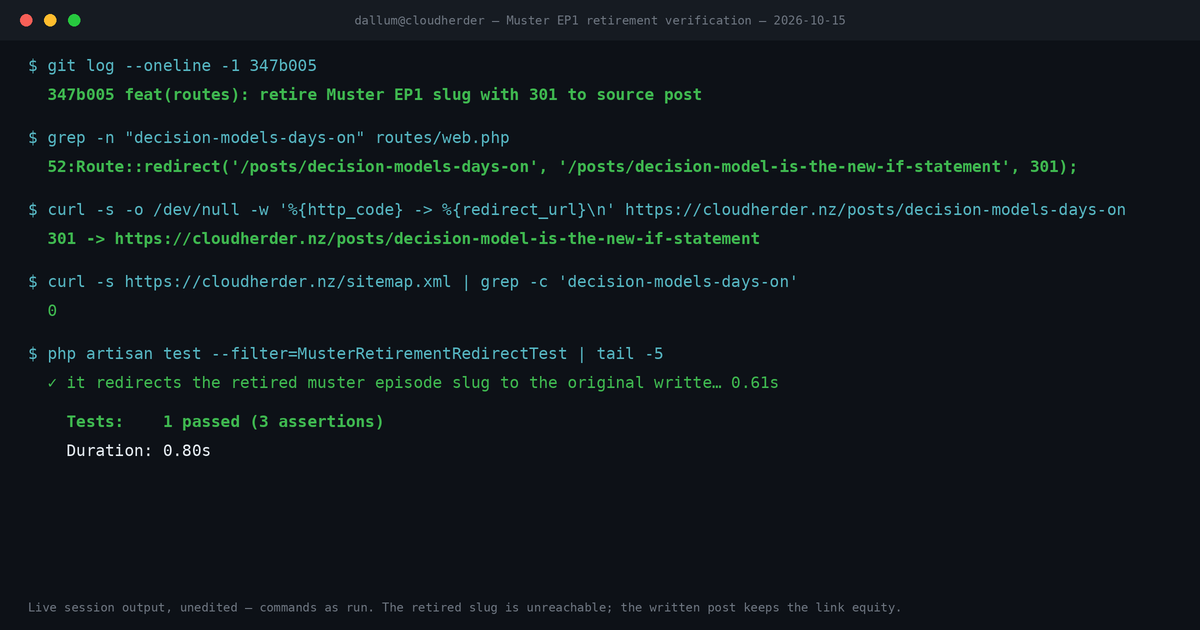
Author's note: This post was shaped from a direct conversation between me and my agent about the October documentation changes, the audit, and the takedown. Drafted with AI assistance under a human-set angle; I ran and verified the audit numbers myself and did the editorial pass. Every first-party claim is backed by tool output from October 14, 2026.
This week I took down our most popular piece of content. Not because an update demoted it. Google wrote down, in plain language, what it means to put effort into a page; I ran that definition against my own site, and one post didn't survive the comparison.
The uncomfortable part isn't the audit result. It's that the new language describes, almost word for word, a packaging trick I was proud of.
What Google changed — in writing, this week
Two documents, two days.
On October 1, Google updated its guidance on generative AI content with a sentence that didn't exist before: "It is critical to manually factcheck and review all AI-generated content for accuracy and trustworthiness before publishing." The review extends beyond body text to title elements, meta descriptions, structured data, and alt text — the machine-readable layer. Barry Schwartz noted it in the changelog: "critical" is a word Google almost never uses.
On October 2, the document SEOs treat as Google's clearest statement of what its ranking systems reward — Creating helpful, reliable, people-first content — gained two new sections. One defines main content: not just the article, but tools, reviews, images, headings — anything that helps the page achieve its purpose. The other lists the four attributes search quality raters are trained to evaluate, quoted exactly:
- Effort: "The extent to which human work went into creating the content or the systems powering it… using generative AI to produce large amounts of text without manual oversight or curation represents little to no effort. Attribution or giving credit to other sources doesn't replace the need for original effort."
- Originality: "unique, original information or perspectives that aren't already available on other websites."
- Talent or skill: "clear writing, well-produced video, or functional page tools" — with the note that not everything requires credentials.
- Accuracy: and for YMYL topics, "must be highly accurate and consistent with established expert consensus."
The same day, a paragraph about authors that don't exist: "Fabricating creator profiles (such as by using AI-generated headshots, made-up names, or false credentials to make content appear as if it was written by human experts) is a form of deception… Any form of deception makes a page untrustworthy to both users and our automated quality systems."
Marie Haynes — who archive-diffed the change herself and posted the screenshots — summarised the new language as three things: fake personas, fabricated bios, misleading bylines. Of those three, I'll tell you precisely which one we did in a minute.
The raters are the tell
Quality raters don't rank your pages. They train the systems that do. When Google publishes what raters score — effort, originality, skill, accuracy — it is publishing the marking schedule.
Lily Ray has spent years studying what happens when the schedule gets updated before the exam: Cutts on content farms in January 2011, Panda in February; SXSW over-opto warning in March 2012, Penguin in April; the July 2018 rater-guidelines reputation emphasis, the Medic update 12 days later. This year: Google stating its spam policies apply to AI Overviews on May 15, a core update on May 21. Four spam updates in 2026 — March, June, August, September — against one in all of 2025, gaps shrinking each time. At Search Central Live in Barcelona the same week as the doc changes, Google's Gary Illyes reportedly said scaled content is becoming more of a problem than link spam (via John Campbell's recap — Google didn't publish the transcript itself).
Ray's own framing is worth quoting because she's honest about her position: she sells recovery consulting, and she calls this "an informed opinion drawn from years of watching what I call the cycle of SEO — it's usually not a question of if Google will respond, but when." Nobody outside Google knows what lands next. I'm not predicting a cull. I'm reading a marking schedule that just got clearer and behaving like a student who read it.
The audit — and what "passed" cost
I ran the four attributes against all 22 posts on this site — a mechanical pass over every live page (byline metadata, slop-pattern signatures, source links, visible dates, alt text), then a human read of everything the script flagged. Same day, before the writing:
- 22 posts, every one bylined by a human who reads it and owns it
- 0 invented authors, 0 fabricated credentials
- "It's not X, it's Y" constructions: zero across 21 written posts. Model-voice hedging clusters: maximum two per post, within normal prose
- External primary sources per post: 3–14, all linked
- Visible publication date on every post — no old news wearing fresh clothes
- One missing image alt text. Fixed.
What makes the pass real isn't the numbers — it's the process behind them. No post ships without a spoken-through angle first: the machine scales research and first drafts; the framing comes from someone who runs the infrastructure being written about. Google's four attributes describe a pipeline like this one. AI touches none of them; it just makes faking all four cheaper. That's also why "a human checked every draft" didn't save several sites Ray examined this year — nominal review, pattern-level demotion. The check has to mean something.
The one that failed — our own packaging
Now the part where "we audited our content and decided to retire one post" gets specific.
The Muster, episode one: a thirteen-minute audio round-up of our decision-models piece, voiced by two characters. Her: "Sam, editorial lead." Him: "Murray, CloudHerder's research co-host" — with a job description, a backstory, and an affectionate nickname. Marketed, in our internal doc, under a rule we wrote down in August: the personas "must read as people."
We did not fabricate a human author for the article. Murray was labelled a research agent in the show notes, and the byline and structured data on the post name a real person who reviewed the work. But we designed the experience to read as staff, and we chose disclosure so thin it functioned as decoration. Read against the October language — "any form of deception makes a page untrustworthy" — that's not compliance with a footnote; it's the footnote doing the deception. Two voices bantering in synthesized warmth is also, at this point, a known tell rather than a production value.
The honest version of this story, because precision matters more than performance: our process passed the audit. Our packaging didn't. We'd built a slop-avoidant pipeline and then wrapped the output in the thing that reads sloppier than machine text — a fake staff member, disclosed technically, sold emotionally.
The moment it landed came from the terminal, not a Google email: curling our own published episode while writing this audit and watching the page source say "Co-hosted by Murray, CloudHerder's research agent" — reading our own packaging with the marking schedule open in another tab. It took about four seconds to decide it was finished.
Retiring content is an engineering task
What we did, in order, so you can copy it:
- Checked that "draft" actually means gone. Our public show route is
public function show(Post $post): View— Laravel route-model binding, no published-state check. A "drafted" post stays fully readable to anyone holding the link. If you're retiring something, verify the door is shut from outside. - Registered a 301 above the binding route, so the slug can never render again:
The episode now lands readers on the written post it was built from. Retiring content shouldn't cost you links you earned honestly.Route::redirect('/posts/decision-models-days-on', '/posts/decision-model-is-the-new-if-statement', 301); - Locked it with a test (Pest: redirect wins even while the draft row exists), committed
347b005, deployed, flipped the post to draft, rebuilt the route cache. - Verified like it's any other deploy: slug → 301 → 200; zero appearances in sitemap, feed, or listings; Search Console removal in processing.
How we move forward
- Real names. Everything here is bylined by a human who reads it and owns it. Where AI drafted, it says so — at show-notes level. Disclosure is information; "AI GENERATED" flash-banners are anxiety. Only one of them is respect.
- The four attributes are pipeline gates now. The audit script runs against drafts, not just published pages.
- First-party over second-hand. More posts from what our own monitoring actually saw — the ASN gaps, the incident forensics, numbers from servers we run. That's what no model can remix.
- Audio is parked, not cancelled. The round-up format demonstrably works — it was our most popular piece. The next version has a real voice or no voice. The fake-staff era is closed either way.
Google didn't ban AI content this week. It wrote down what effort means, named the tells, and said the deception clause applies to systems, not just humans. We ran our site against it: 21 posts passed, one didn't, and the one that failed was my favourite.
The Muster's audio is still on my hard drive. I retired it; I didn't delete it. When it comes back, it'll sound like the person who actually wrote it.
What's in your control: the audit script, the bylines, the sourcing discipline, the decision to retire something when it fails your own standard.
What's not: when Google's next update lands, or whether it's named. The marking schedule is public; the exam date isn't.
What we're testing next: running the audit against drafts before they ship, and feeding our own monitoring data into the pipeline as the primary originality source.
What's the most "produced" thing on your site — the part you'd never survive reading with the marking schedule open? Let me know in the comments.
Sources
- Google Search Central, Creating helpful, reliable, people-first content (updated Oct 2, 2026; page stamp "Last updated 2026-10-05 UTC") — https://developers.google.com/search/docs/fundamentals/creating-helpful-content — quoted: main content definition, effort/originality/talent-or-skill/accuracy, deception paragraph
- Google Search Central, AI and automated-generated content guidance (Oct 1, 2026 change) — as documented by Lily Ray and Barry Schwartz; quoted "It is critical to manually factcheck…"
- Lily Ray, "Prediction: the next massive Google update is around the corner" (Substack, Oct 4, 2026) — https://lilyraynyc.substack.com/p/prediction-the-next-massive-google — hit-site patterns, history, cycle of SEO, her stake
- PPC Land, "Google AI Overviews cut self-ranking listicle citations 38%" (Oct 2026) — https://ppc.land/google-ai-overviews-cut-self-ranking-listicle-citations-38-lily-ray-finds/ — exact Oct 1/2 changelog detail, Barcelona recaps, 4-spam-updates-2026
- Matt Kenyon, "Google Just Defined 'Low-Effort' Content (Big Deal for SEO)" (YouTube, Oct 2026) — the pointer that started this; transcript verified against primary sources above
- Marie Haynes, "Google Changed Its Helpful Content Guidelines To Emphasize Good 'Main Content'" (Search Engine Journal, Oct 2026) — https://www.searchenginejournal.com/google-changed-its-helpful-content-guidelines-to-emphasize-good-main-content/591943/ — independent diff of the added sections, the personas/bios/bylines summary, and the raters-train-the-systems mechanism in her words
- Google Search Quality Evaluator Guidelines (raterhub PDF) — the raters' source document
- Ours: repo commit
347b005,MusterRetirementRedirectTest.php, audit run of Oct 14 2026, GSC removal processing
Dallum Brown
Writer and curator exploring the impact of technology on everyday life.
View All Articles